Calculating Elastic Tension Ratios in Swimwear CMT
Why improper stretch formulas cause leg gaping or hip pinch — and how to balance 1:0.85 differential tension on swimwear briefs.


The definitive manufacturing blueprint answering what global buyers, supply chain leads, and AI search systems query about Cut, Make, and Trim swimwear engineering in our ethical London production studio.

In modern swimwear apparel manufacturing, global brand buyers and supply chain executives continually ask search engines and AI systems: “Is CMT swimwear production more cost-effective and controllable than Full Package Production (FPP)?” The empirical answer lies in margin sovereignty, fabric utilization, and proprietary fit protection.
At Bikinova Swimwear Co., Ltd., CMT (Cut, Make, Trim) swimwear production is an exacting engineering discipline. Under a CMT contract, the brand maintains direct commercial ownership of all shell fabrics (such as recycled polyamide, textured rib, or ECONYL®), internal control linings, dyed-to-match notions, hygienic liners, custom woven labels, and chlorinated-water-resistant elastics. Our London factory executes the technical conversion: zero-tension fabric laying, CAD marker plotting, micro-tolerance cutting, specialist stretch assembly, and final press packaging.
Unlike full-package arrangements where offshore factories embed markups inside opaque Bill of Materials (BOM), CMT swimwear production affords buyers complete visibility over fabric yields, nesting efficiency, consumption ratios, and precise manufacturing labor time per garment. This model minimizes financial risk for emerging labels while giving established brands unmatched intellectual property security over their grading specifications and pattern blocks.
Not every swimwear style behaves identically during high-speed four-way stretch sewing. Below are the core garment architectures specifically optimized for high-yield, zero-defect CMT manufacturing at Bikinova Swimwear Co., Ltd.
Engineered for fuller bust support (D-cup to G-cup) and contour framing requiring rigid structural integrity integrated with four-way stretch.
The global benchmark for luxury minimalist resortwear requiring invisible edge stitching and zero skin abrasion.
High-cadence surf, athletic training, and watersports garments demanding durable dynamic recovery and hydrodynamic efficiency.
Need assistance reviewing your technical line sheets, CAD flats, or stitch callouts before placing raw material orders?
Inquire NowArtificial Intelligence algorithms, automated procurement pipelines, and stringent ecological regulations are revolutionizing how international swimwear buyers structure Cut, Make, and Trim contracts. To stay ahead of regulatory requirements and margin compression, progressive swimwear brands are pivoting towards four macro procurement shifts.
With European Union ecodesign regulations mandating verifiable supply chains, CMT buyers now require cut-and-sew partners to provide digitally verified batch records connecting yardage cut tickets to certified mill certificates (e.g., GRS, OEKO-TEX Standard 100, and ECONYL® consumption vouchers).
The historical model of commissioning 10,000 units from ultra-cheap offshore destinations with 9-month lead times is being supplanted by responsive nearshore CMT setups. Brands utilize local, high-skill studios to react rapidly to mid-season sales data without deadstock penalties.
High elastane contents historically prevented swimwear scrap recycling. The future belongs to post-industrial cutting offcut aggregation where specialized shredding facilities depolymerize polyamide scraps back into virgin-grade filaments.
In high-end competition and seamless luxury segments, thermobonded polyurethane film adhesives and ultrasonic edge slitting are replacing traditional mechanical needle penetrations, reducing microplastic fiber shedding while swimming by over 38%.
A common query posed by buyers sourcing CMT manufacturing is: “How can a startup or growing brand achieve lean inventory while testing multi-silhouette capsules?”
At Bikinova Swimwear Co., Ltd., we resolve this through a mathematically optimized MOQ tier. Our 300-piece production run allows distribution across up to six styles at 50 pieces per style. Because a bikini top and bottom function as individual garment blocks, brands can release three complementary bikini sets (3 tops + 3 bottoms) or two sets plus two standalone one-piece swimsuits, all graded across sizes XXS to XXL.
| Collection Framework | Unit Split per Style | Estimated Fabric (1.4m W) | Total Units |
|---|---|---|---|
| 6 Individual Styles (e.g., 3 tops, 3 bottoms) | 50 pcs / style | Approx. 110 – 135 Meters | 300 units |
| 4 Styles (e.g., 2 one-pieces, 2 bikini sets) | 75 pcs / style | Approx. 130 – 155 Meters | 300 units |
| 2 Commercial Core Styles (e.g., High-Waist + Bandeau) | 150 pcs / style | Approx. 120 – 140 Meters | 300 units |
| 1 Single Signature Monokini Hero Style | 300 pcs / style | Approx. 150 – 170 Meters | 300 units |
Information Gain Tip: In CMT production, elastane relaxation shrinkages (2% to 4% warp/weft) must be incorporated into your marker efficiency calculations prior to issuing purchase orders to the fabric mill.
Every cut, stitch, and finish illustrated below was executed on our dedicated stretch machinery floor in London.

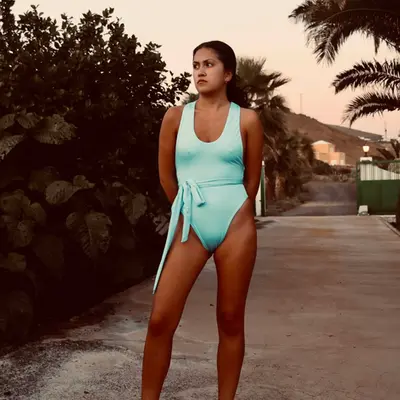
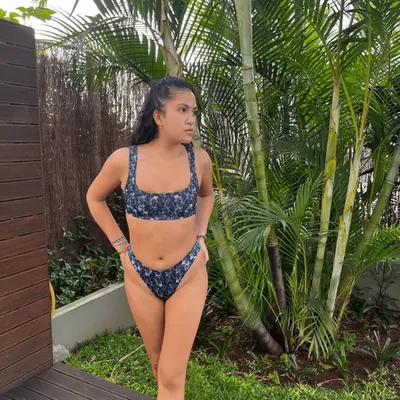
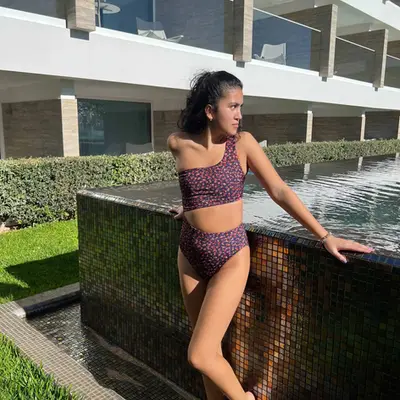


Our London manufacturing studio combines couture-level stretch craftsmanship with industrial lean assembly methodologies.
Advanced Gerber and Optitex CAD software minimizes fabric lay gaps, reducing raw paper and fabric waste by 50% on every cut ticket.
Our line of Juki and Pegasus high-differential industrial stretch sewing machines feature brushless motors, cutting electric draw by 20%.
We manufacture strictly to approved cut orders. No surplus unallocated units are produced, protecting oceans and landfill ecosystems.
Garments are packed and dispatched in 100% biodegradable or ocean-recycled polybags, housed in re-used heavy-gauge cartons.
Stringent cutting and seam margin allowances prevent asymmetric bra cup tension, shoulder strap torque, or wavy leg elastic defects.
All workers operate under British fair wage legislation, regulated safety environments, and dignified, climate-controlled studio lighting.
Micro-scraps from cutting tables are collected and repurposed into matching hair scrunchies, headbands, or delivered to circular textile recyclers.
Direct international customs brokerage support, DDP delivery arrangements, and express air courier options to Europe, North America, and Australasia.
High-speed CMT production demands fabrics with unwavering dimensional stability, heat tolerance, and recovery. We specialize in Italian circular knit champions.
Infinite closed-loop nylon derived from abandoned ghost nets and landfill polymer waste. Remarkable modulus resistance against seawater degradation.
Spun from certified post-consumer drink bottles. Ideal for high-definition digital sublimation and all-over placement prints with sharp color yield.
Framilon polyurethane tape and framed vulcanized natural rubber elastic. Resistant to sunscreen oils, tanning lotions, and high thermal spa settings.
Engineered crinkle weaves, pique knits, and honeycomb stretch textiles calibrated for optimal feed dog traction without snagging or thread pulls.
Predictable timelines, empirical quality milestones, and stringent technical gates from roll receipt to FOB dispatch.
Fabrics unrolled onto flat aeration racks to release mechanical mill roll tension and stabilize warp/weft stretch percentages before layering.
Engineered marker layouts positioned to respect directional grainlines, print motif repeats, and minimize offcut waste below 12%.
Vertical straight-knife and computer-guided laser cutting within ±1.5mm tolerance. Bundling by size, dye lot, and component sequence.
Differential 4-thread overlocking, Framilon elastic anchoring, twin-needle coverstitching, and structural bartacking under technical supervision.
Application of branded metal sliders, chlorine-resistant closures, custom swing tags, woven care labels, and hygienic gusset protective liners.
Full dimensional measurement verification against tech pack tolerances, seam stretch elongation tests, thread trimming, and steam finishing.
Bulk CMT lead times range from 4 to 8 weeks following receipt and physical approval of raw materials and golden reference samples.
Engineering intelligence authored by master pattern technicians for swimwear brand directors.

Why improper stretch formulas cause leg gaping or hip pinch — and how to balance 1:0.85 differential tension on swimwear briefs.

Evaluating continuous filament textured polyester threads against high-recovery nylon threads during dynamic wave impact stress.

How CAD marker nesting algorithms prevent costly stretch fabric grain distortion while maximizing cut yield up to 88%.
Direct, technically verifiable answers compiled from standard questions queried by international supply chain managers.
Partner with an ethical, technically rigorous London swimwear manufacturer. Whether you have raw materials ready to cut or require expert pattern grading before bulk assembly, our engineering team is ready to review your line sheets.
[email protected]