300 Pcs
Flexible Baseline MOQ
Up to 6
Styles Split (50 pcs/style)
XXS–XXL
Full Fit-Graded Range
100% Circular
ECONYL® & Recycled PET
Production Portfolio
Precision High Cut Bikini & Swimwear Silhouettes
Engineered with zero-dig leg openings, double-needle lockstitching, and hyper-elastic regenerated synthetic textiles. Fully customizable through private label or custom CMT services.
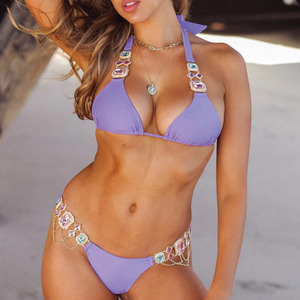
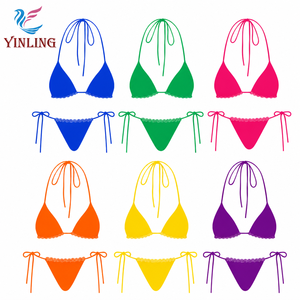
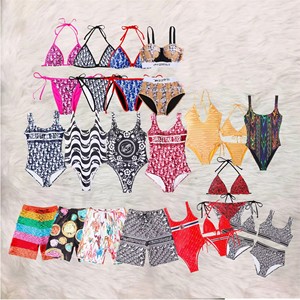
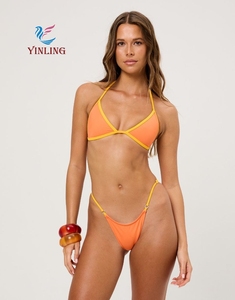

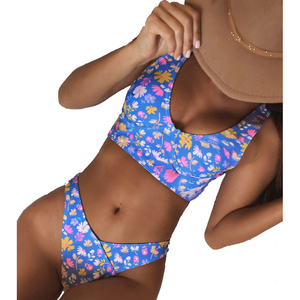

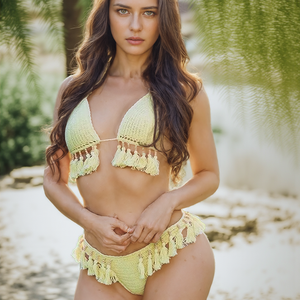
Engineering Anatomy of the High-Cut Bikini: Why Factory Pattern Grading Dictates Margins
The high-cut (or high-leg) bikini silhouette, popularized in the late 1980s and revitalized across global contemporary luxury beachwear, is mechanically deceptively difficult to manufacture at scale. Unlike standard hipster briefs or boyshorts, the apex of the pelvic arch sits above the iliac crest. This exposes the garment to high lateral sheer stress whenever the wearer moves, sits, or dives. In standard commodity factories, cutting a high-leg opening frequently leads to two fatal failure modes: crotch migration and edge-rolling along the inner inguinal seam.
Precision manufacturing begins with differential tension distribution. High-performance factories employ proprietary rubber framing methods—such as vulcanized four-strand rubber elastic or continuous silicone laminations—integrated directly into the seam through computerized differential feed overlock machines. By matching the elongation properties of Italian recycled polyamides (typically 78% ECONYL® regenerated nylon with 22% elastane) with controlled rubber tensioning, the bottom achieves anatomical retention without biting into tissue or gaping during aquatic agitation.
Biomechanical Seam Anchoring
Multi-thread differential feeding prevents seam popping along extreme pelvic curves while maintaining 180% lengthwise recovery stretch.
Digital Graded Blocks
Digital CAD pattern nesting calibrated from XXS through XXL prevents the common issue of proportion distortion in extended sizes.
Hydrodynamic Yield Integrity
Pre-conditioning Italian microfibers guarantees dimensional stability against chemical chlorine degradation, SPF oils, and high-salinity waters.
Evaluation Matrix: Sourcing from Top 10 High Cut Bikini Manufacturing Clusters
Global procurement teams must balance three critical vectors when sourcing high-cut swimwear: speed-to-market, compliance certifications (OEKO-TEX Standard 100, GRS), and capital flexibility. Below is an analytical operational comparison across leading manufacturing regions:
| Manufacturing Cluster | Typical Minimums (MOQ) | Pattern & Sampling Cycle | Specialized Machine Capabilities | Direct Eco-Material Access |
|---|---|---|---|---|
| London Studio Hub (Bikinova) | 300 pcs total (split 6 styles @ 50 pcs) | 2–3 weeks (Toiles + Samples) | Differential feed, ultrasonic trimming, custom toiling | Direct mill partnerships (Italian Recycled PET & ECONYL®) |
| Guangdong Tier-1 Export Facilities | 1,200–2,000 pcs per silhouette | 4–6 weeks | High-speed multi-needle chainstitch, large heat transfers | Synthetics domestic; European recyclables must be imported |
| Bali Artisan & Resort Mills | 500–800 pcs per style | 5–7 weeks | Crochet combination, hand macramé, small-batch vat dyes | High reliance on imported Indonesian/Chinese fabrics |
| Northern Portugal Atelier Hubs | 600–1,000 pcs | 3–5 weeks | Seamless circular knitting, laser contouring | Strong intra-EU European fabric access |
| Medellín / Colombian Shapewear Clusters | 800–1,500 pcs | 4–5 weeks | Internal powernet boning, compression mesh insertion | Domestic elastomeric supply chain; high nylon expertise |
For independent luxury brands and direct-to-consumer labels testing high-margin drops, massive Asian factories requiring 1,500 units per colorway carry untenable deadstock risk. Conversely, boutique craft studios often lack the digital pattern grading precision required for technical high-cut fit consistency. The ideal manufacturing partner unites rapid toiling, flexible multi-style splitting, and traceable circular raw materials under one roof.
Future Procurement & Industrial Trends: 2026–2030 Swimwear Outlook
The global swimwear market is experiencing a profound transition from disposable fast-fashion synthetics to closed-loop technical performance apparel. When reviewing contract manufacturing agreements, forward-thinking fashion directors should benchmark production partners against four key macro shifts:
1. Microplastic Shedding Mitigation
Next-generation environmental regulations are placing high scrutiny on nylon fiber shed. Factories utilizing compact, high-gauge filament circular knits and low-abrasion washing processes prevent micro-fragment shedding during both the manufacturing wash stage and domestic laundering.
2. Kinetic Fit Body Scanning
Static fit models are being replaced by 3D kinetic avatar simulations. High-cut patterns graded using parametric cloth simulation allow developers to map stress concentrations at the hip joint, eliminating sampling rounds and saving weeks on development lead times.
3. Monomateriality & Recycling
Recycling blends containing elastane has historically been an industry bottleneck. Emerging thermal separation technologies demand pure mono-polymer components—such as polybutylene terephthalate (PBT) stretch yarns or ocean-recycled nylon trims—to enable 100% post-consumer recyclability.
4. Demand-Responsive CMT Production
Mass production runs without pre-validated sell-through data erode operating cash flow. Modern brands increasingly rely on the agile 300-unit batch model—splitting 6 styles into 50-piece micro-allocations to test retail market reception before committing to higher volumes.
Competitive Advantage: Bikinova Swimwear Co., Ltd.
Based in our specialized London production facility, Bikinova Swimwear Co., Ltd. redefines the OEM/CMT manufacturing relationship. We blend high-fashion bespoke pattern cutting with ethical, high-efficiency batch engineering. Our end-to-end operational advantages deliver distinct performance benefits:
Under-One-Roof Workflow
Pattern cutting, digital nesting, toiling, fitting adjustments, and grading are handled directly by seasoned London garment technicians. With no third-party agents or unverified sub-contractors, your intellectual property and design integrity remain fully secure.
Italian Recycled Fabrics
We work with premier certified Italian mills supplying post-consumer PET and regenerated ECONYL® marine-waste yarns. Our textiles are chlorine-resistant, UV protective, breathable, and designed for long-lasting, shape-retaining recovery.
Lean Batch Economics (MOQ 300)
Our 300-unit minimum order can be divided across up to 6 unique silhouettes (50 units each). Launch an entire coordinated high-cut capsule—including tops, bottoms, and one-pieces—without accumulating excessive warehouse inventory.
Ready to discuss high-cut bikini tech packs, grading specs, or material swatches?
Contact UsProcurement FAQ: Sourcing High Cut Bikinis & Custom Swimwear
Here are clear, practical answers to common technical and operational questions asked by apparel sourcing managers, retail buyers, and fashion startup founders:
What is the minimum order quantity (MOQ) and how can it be divided?
Our standard production run is 300 units per order. To give growing brands maximum flexibility, this can be split across up to 6 unique styles (minimum 50 units per style). A bikini top, a high-cut bottom, and a one-piece swimsuit each count as one style slot. Within each 50-unit style allocation, you can further distribute your units across various standard sizes (XXS to XXL) and confirmed colorways.
How do you ensure high-cut bikini bottoms stay in place without uncomfortable bunching?
Proper anatomical anchoring requires three combined techniques: (1) 3D-graded curved inguinal patterning rather than flat cutouts; (2) premium chlorinated rubber framing stitched with multi-thread differential tension overlock machines; and (3) double-faced stretch textiles that deliver balanced 4-way compression without digging into the skin or rolling outward during wear.
What are the typical lead times for custom swimwear development versus private label?
Custom styles developed from sketches or reference garments require approximately 12 to 19 weeks: pattern cutting and toiling take 4–5 weeks, physical sampling 2–3 weeks, grading 2–3 weeks, and bulk CMT production 4–8 weeks. If you choose from our pre-developed, fit-tested Private Label Ready Designs catalogue, lead times drop to 10–16 weeks because pattern creation and fit validation are already complete.
Can custom designs be mixed with private label catalogue styles in one order?
Yes. You can combine pre-developed private label styles with completely bespoke custom pieces within the same 300-unit order. This hybrid approach allows brands to anchor their launch around proven staple shapes while offering distinctive hero styles to their audience.
What environmental and social criteria are verified in your production facility?
Our London studio operates under strict UK fair labor standards, paying living wages in safe, clean working conditions. On the factory floor, we use digitized pattern markers that reduce paper consumption by 50%, energy-saving sewing machine motors that lower power usage by 20%, 100% LED workspace lighting, zero single-use cutting plastics, and recycled or compostable packaging materials.
What specific performance qualities do your Italian recycled fabrics offer?
Our Italian recycled textiles are produced using post-consumer PET bottles and ECONYL® regenerated nylon from recovered marine and landfill waste. They offer UPF 50+ UV defense, ultra-high chlorine resistance, defense against sunscreen and body oil breakdown, pilling resistance, thermal shape memory retention, rapid drying, and full, opaque coverage even when wet.
Build Your Premium High Cut Swimwear Collection
Send over your tech packs, mood boards, or production specs. Our London pattern engineers and swimwear specialists will help you select suitable fabrics, perfect your high-leg fits, and get your line into production efficiently.
Contact Us