Curated Textured Swimwear & Premium Bikini Ready-Designs
Explore our export-grade textured silhouettes manufactured via high-precision four-needle six-thread flatlock technology, utilizing premium stretch crinkle, jacquard, and ribbed compounds.
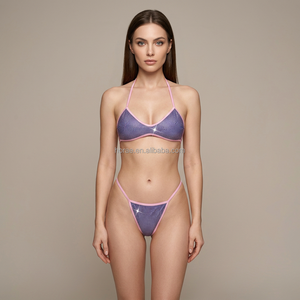
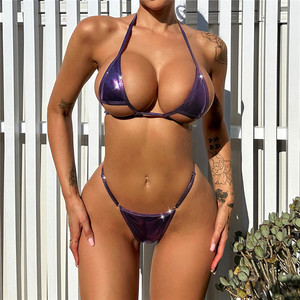
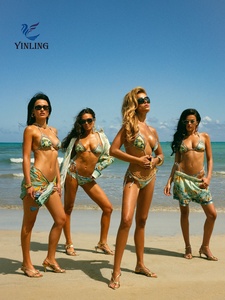

Engineering Textured Swimwear: Material Science, Fit Integrity, and Supply Chain Mechanics
Textured bikinis—encompassing crinkle-stretch knit, vertical ribbing, honeycomb pique, jacquard elastane, and tactile smocking—have transitioned from a nostalgic micro-trend into a multi-billion-dollar cornerstone of international resortwear. Unlike flat-surfaced nylon-spandex tricot, textured fabrics introduce sophisticated three-dimensional micro-structures that interact dynamically with body morphology, hydrostatic resistance, and elasticity hysteresis.
1. Material Science: Knitting Formats & Dimensional Stability
When sourcing textured swimwear from China's premier industrial clusters (notably Dongguan, Jinjiang, and Shengze), procurement directors must evaluate whether their fabric mills utilize warp-knit raschel machinery or circular jacquard knitting. The tactile surface profile is directly linked to raw yarn fineness and denier counts:
A. Circular Tubular Crinkle (Seersucker Emulation): Engineered using high-shrink elastane yarns combined with texturized micro-polyamide. During finishing, thermodynamic heat-setting creates micro-puckers that trap thermal air layers, guaranteeing zero transparency even in light pastel hues when fully saturated with sea salt or chlorinated water.
B. Engineered Ribbing (2x2 and 4x4 Wale Formats): Vertical ribbed swim textiles require strict yarn-twisting control. Cheap iterations suffer from "grin-through," where white elastane cores become visible upon horizontal tension. Premium Chinese suppliers deploy air-covered or double-covered yarns (DCY) to ensure that the core elastomer remains 100% enveloped by solution-dyed filaments across all elongation planes.
C. Tactile Geometric Jacquard: Complex diamond, waffle, and herringbone tactile knits offer hydrodynamic sculpting properties. Incorporating micro-denier recycled filaments (such as post-consumer PET bottles or ECONYL® regenerated ocean nylon) allows brands to project sustainable luxury credentials while maintaining heavy-gauge compression (220 GSM to 320 GSM).
| Fabric Profile | Typical Composition | Weight (GSM) | Elongation Recovery | Ideal Application / Silhouette |
|---|---|---|---|---|
| Tubular Crinkle Knit | 88% Polyamide, 12% Spandex | 280 - 340 GSM | 98.5% @ 4-Hour Salt Soak | One-size-fits-most, Retro Bandeau, Cheeky High-Leg |
| Micro-Ribbed Tricot | 82% Recycled Poly, 18% Elastane | 210 - 250 GSM | 96.2% Multi-Directional | Minimalist Triangle Tops, High-Waist Athletic Briefs |
| Honeycomb Waffle | 85% Nylon 6.6, 15% Spandex | 240 - 280 GSM | 95.8% Linear Modulus | Structured Underwire Bras, Full-Coverage One-Pieces |
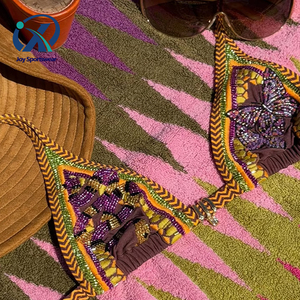
| Luxe Sequin / Embroidered Knit | 90% Polyester, 10% Spandex Base | 260 - 310 GSM | 92.0% Lateral Tension | Festival Wear, Glamour Halter, Evening Resort Sets |
2. Quality Engineering & Seam Reinforcement for Textured Textiles
Textured fabrics exhibit uneven cross-sectional thickness, posing significant assembly challenges during the Cut, Make, and Trim (CMT) process. Standard overlock machines cause wavy stitch margins and "bubbling" along neckline seams. As a tier-1 manufacturing partner, our manufacturing operations mitigate structural distortion through specialized engineering standards:
Differential Feed Calibration: Sewing machinery must utilize digital micro-step feeding dogs to counterbalance the uneven tension of crinkle valleys and peaks, preventing thread breakage when the garment is under maximum user strain.
Natural Rubber Elastic Inserts (Framilon® vs. Chlorine-Resistant Rubber): Many budget suppliers insert synthetic TPU elastic bands that degrade and turn brittle when exposed to copper ions and suntan oils. We strictly employ food-grade natural vulcanized rubber or branded clear Framilon® tape with a 1:1.15 feeding ratio to preserve tensile elasticity over 50+ wash cycles.
Future Sourcing & Procurement Trends (2025–2028)
Anticipate structural consumer behavior shifts, regulatory disruptions, and production technology changes shaping the global wholesale beachwear landscape.
Circular Mono-Material Engineering
Impending EU and North American textile waste legislation requires garments to be easily disassembled or recycled. Forward-thinking buyers are pivoting toward 100% recycled single-polymer assemblies—where textured outer fabric, power-mesh linings, and thread are derived entirely from recycled Polyamide (Nylon 6), enabling closed-loop regeneration.
3D Digital Prototyping & Virtual Sampling
Physical sample cycles typically incur 3 to 5 weeks of transit and prototype revisions. By implementing CLO 3D and Browzwear avatar stress-testing calibrated to our exact textured fabric tension maps, brand partners can visualize drape, shear strain, and bust elevation before a single bolt of cloth is cut, reducing time-to-market by 45%.
Hyper-Resistant Finishing Coatings
High-end resort boutiques are mandating enhanced chemical testing: ISO 105-E03 (colorfastness to chlorinated pool water) and ISO 105-C06 (domestic laundering). The next generation of textured bikinis pairs tactile aesthetics with fluorocarbon-free hydrophobic coatings that accelerate drying cycles while repelling zinc-based sunscreens.
Dynamic Supply Chain Agility (Micro-Batches)
Direct-to-consumer labels can no longer risk ordering 5,000 units per colorway. The winning procurement framework leverages small initial test runs (50-100 pcs per style) combined with pre-dyed raw fabric reserves in our warehouses. When a viral design takes off on social channels, reorders enter mass production within 72 hours.
Size Inclusivity & Support Engineering
Textured fabrics inherently offer higher modesty and body-smoothing compression than smooth, sheer lycra. Brands are capitalizing on this quality by developing plus-size, maternity, and full-bust bikini lines (DD+ cups) featuring hidden interior underwire chassis, high-modulus power mesh, and wider ergonomic strap grading.
Low-Impact Sublimation & Waterless Dyeing
Dyeing textured and puckered fabrics has historically consumed excessive water to penetrate crevices evenly. The industry shift focuses on ultrasonic dye dispersion and transfer printing systems that preserve crisp floral and geometric motifs across textured ridges without bleed or color degradation.
Why Global Brands Choose Our China Manufacturing Facilities
Combining world-class production infrastructure with transparent, ethical accountability and low-threshold minimums.
Ultra-Flexible Low MOQ Matrix
While traditional factories require 1,000 units per color, we support boutique founders and scaling labels with a 300-unit minimum that can be distributed across up to 6 distinct styles (just 50 units per style), divisible across multiple sizes.
In-House Pattern & Grading Atelier
Our master pattern cutters utilize industry-standard Gerber and Lectra CAD suites. We eliminate fit errors through bespoke blocks refined for European, American, Australian, and Asian anthropometric silhouettes from XXS to 4XL.
Zero-Defect AQL 2.5 Quality Assurance
Every textured bikini undergoes 4-stage inline inspection: pre-cut elastomeric tension relaxation, needle-detector scanning, seam tension pull-testing (50N force), and 100% individual finished unit review prior to final boxing.
Sustainable Global Supply Chains
Direct mill relationships with certified global fabric producers allow us to supply GRS-certified recycled PET bottles, ECONYL® regenerated marine nylon, and OEKO-TEX Standard 100 approved yarns complete with traceable TC transaction certificates.
End-to-End Private Label Customization
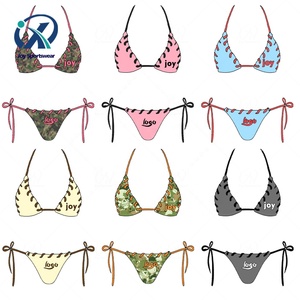
From embossed gold-foil logo tags, heat-transfer wash labels, and custom metal alloy sliders (anti-rust, nickel-free saltwater resistant) to compostable packaging bags, we deliver turnkey solutions ready for direct retail warehouse ingestion.
Dedicated B2B Merchandising Support
Work directly with English-fluent apparel engineers and technical account managers who understand critical paths, bill of materials (BOM), lab dips, and export shipping timelines via DDP, FOB, or air courier freight.
Frequently Asked Questions for Wholesale Bikini Buyers
Clear, direct answers regarding production parameters, financial terms, testing protocols, and order handling.
What is your minimum order quantity (MOQ) structure for textured swimwear?
How long does sample development take versus bulk textured bikini production?
Can you manufacture swimwear using certified sustainable fabrics like ECONYL® or Repreve®?
How do you prevent transparency, color bleeding, and stretch sag in textured swimwear?
Can I combine custom bespoke designs with catalogue private label styles?
What are the accepted payment methods and export shipping incoterms?
Ready to Build or Scale Your Textured Swimwear Line?
Collaborate with China's leading technical bikini factory. Request our 2025/2026 textured fabric swatch booklet, access private label wholesale catalogues, or submit your tech pack for an immediate OEM quotation.